

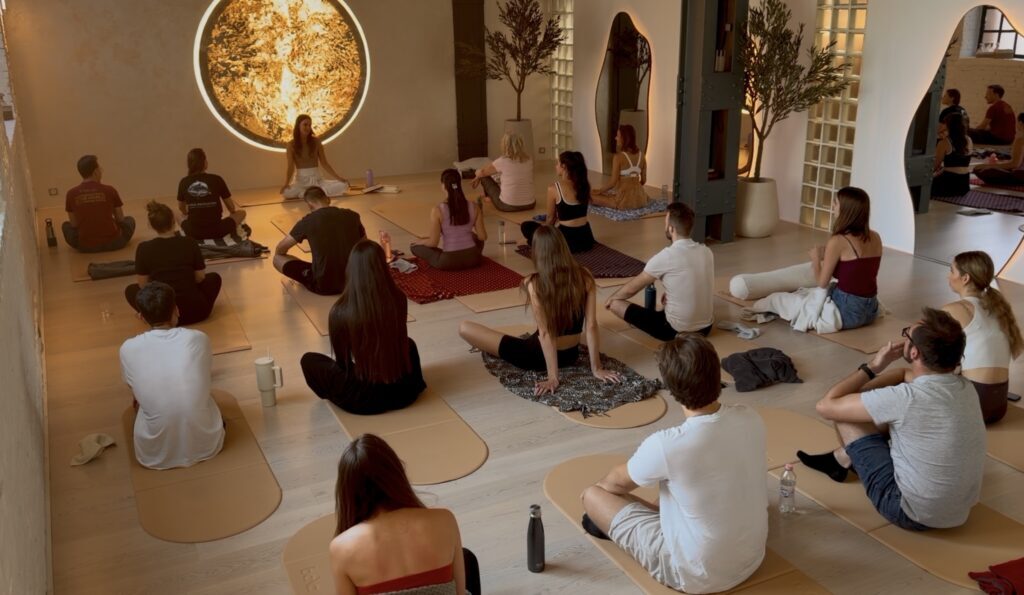
Here's what you should know before you try it
Maybe a friend recommended breathing therapy to you, or maybe you just came across it on Instagram: the breathwork, that is, breathwork It's been popping up in a lot of places lately.
But let’s face it: most people don’t look into it because they’re curious about a new trend. It’s because they’ve already tried so many things. Maybe you, too, have spent years on self-improvement, gone to talk therapy, read half a dozen self-help books—and in the process, learned a lot about yourself.
And yet, deep down, you feel that you're running the same laps as before.
You see and understand your own patterns—including the transgenerational traumas you’ve inherited from your parents and grandparents—yet nothing really changes.
Your body tenses up just the same in a conflict situation. The same old reactions kick in before you even have a chance to think them through.
So let's take a look together: what exactly is breathwork, where does it come from, and what can you expect from it if you ever decide to give it a try.
Trauma-Informed Breathing Therapy and Breathing Exercises
Before we get started, it’s worth clarifying an important distinction.
A breathing exercises – such as the 4-7-8 technique or box breathing – are great, quick tools for those stressful moments. They calm you down, help you fall asleep, and help you stay focused before an important meeting. They have a place in your life, and it’s worth getting to know them.
A trauma-informed breathing therapy On the other hand, it operates at a completely different level. It’s not a technique you apply for a few minutes and then move on—it’s a process in which, through the conscious alteration of your breathing pattern, your body processes what your mind has not been able to process so far: emotions, patterns, and long-held tension.
What is conscious connected breathing?
One of the foundations of respiratory therapy is the conscious connected breathing, which means there is no pause between inhaling and exhaling—your breath flows continuously.
Just how slow, deep, or intense this will be always depends on the specific process and on you. Within a trauma-informed framework, the goal isn’t to breathe as deeply or as quickly as possible—and certainly not to elicit a big, dramatic experience from you at all costs.
Breathing is more like a gateway. A gateway through which your attention slowly lets go of the constant stream of thoughts and moves to where the answers are truly waiting for you: within your body.
Where anything can surface. A tightness in the chest. A held-back sigh, or an emotion that has never before had enough space to be noticed. Other times, there’s simply a sense of calm, lightness, and deep silence. And then there are moments when—at least at first glance—nothing spectacular happens.
Each experience is fine.
Because the goal isn't to „fix” something within you. Rather, it's to help you connect—with curiosity and without judgment—to what is already present within you.
Where does respiratory therapy come from?
Breathing is one of the oldest and most powerful tools humanity has ever discovered for self-discovery. Yogis have known for millennia what Western science is only now beginning to confirm: your breath not only sustains your life, but is directly connected to your state of mind, your emotions, and your nervous system.
A pranayama – a collective term for yoga breathing techniques – is based precisely on this age-old insight: if you change the way you breathe, you also change the way you think, feel, and are present in your own body.
The Western movements known today—the holotropic breathing, the rebirthing, and the methods that grew out of them—which continue to evolve today—were reformulated in the second half of the 20th century within a modern, therapeutic framework, building on this ancient knowledge.
What I do is based on these same principles. With one addition that is essential to me: I work within a trauma-informed framework.
What does „trauma-informed” mean?
For me, this means one thing above all else: the focus of the process is not on intensity, but on safety.
The goal isn't to create the biggest emotional breakthrough possible. You don't have to push past your limits, you don't have to lose control, and you don't have to see anything through just because you started it.
In a trauma-informed setting, every instruction is an invitation—not a command.
You can slow down at any time and return to your natural breathing. You can open your eyes, sit up, change your position, or simply stop.
You stay in touch with your own body. You decide what you're willing to do at any given moment.
My role isn't to tell you how you should feel. I'm there to provide a safe space and guide you at your own pace.
When your breathing pattern changes, your body enters a different physiological state—and this directly affects your nervous system, specifically the part that determines whether you are in danger or safe.
Breathing doesn't lead to change through your thoughts—it leads to change through your body.
That is why this type of work brings about a deeper transformation in so many people than therapies based on words.
Who is breathwork for, and what can you expect during a session?
If you're tired of constantly talking about your problems and would finally like to feel that things are really changing—you've come to the right place.
If you’re familiar with the feeling that, even though you understand everything about yourself in your head, you still end up back where you started; that you find it hard to say no; that your mind rarely gets a break because you’re always the one holding everything together—this process is for you.
A session isn't about having to accomplish something. It begins with getting into the right mindset—you can bring an intention with you if you'd like—followed by a series of conscious, coordinated breaths while lying down with your eyes closed, accompanied by music.
The session concludes with a meditative, integrative phase, during which I’ll guide you with integrative questions to ensure that everything that has come to the surface doesn’t just remain a temporary experience, but brings about real change in your life. There’s no such thing as right or wrong breathing—there are no expectations. All you have to do is show up and let your body guide you at its own pace.
The answer lies within you. It has always been there.


 Hungarian
 English